


6 Driveway Paving Options for a Smarter Kerb Appeal
Driveway paving is often treated as a style choice first, but in the UK it is just as much a drainage and planning decision. Natures Canvas Landscaping, a Berkshire design-and-build landscaping company, approaches driveways as hard landscaping projects where appearance, water management and long-term structure have to work together.
TL;DR: Summary
The best driveway paving option depends first on permeability and drainage, not just colour or pattern; permeable block paving, gravel and porous asphalt are often the simplest UK choices for front drives because they can avoid planning permission when water drains through the surface or into a lawn or border, and Natures Canvas Landscaping treats that as an early design decision.
Planning Portal guidance says a new or replacement driveway of any size usually does not need planning permission if the surface is permeable or rainwater drains to a permeable area; an impermeable front driveway over 5 square metres usually does need it if runoff is not controlled.
Construction details matter: permeable systems need open-graded layers including Type 3 sub-base and 4/20 material, plus the right falls, edge restraints and outlet strategy.
Trade-offs are real: gravel is economical but moves under tyres, block paving is flexible and repairable, resin-bound can look crisp but depends on the build-up, porous asphalt is practical, and natural stone gives a premium finish at a higher cost.
If the site has clay soil, steep levels or heavy vehicle use, choose the drainage method and sub-base before choosing the surface finish.
Homeowners often compare textures and colours before checking the soil, levels and drainage route. Official guidance from GOV.UK, Planning Portal and local authorities points the other way: if the driveway is not designed to handle water, you can run into planning issues, puddling, edge failure and early repairs.
Why does drainage matter as much as appearance for driveway paving?
Drainage controls compliance, durability and day-to-day performance. Planning Portal and GOV.UK both make clear that driveway paving is not only about the top surface; it is about where rainwater goes once it lands.
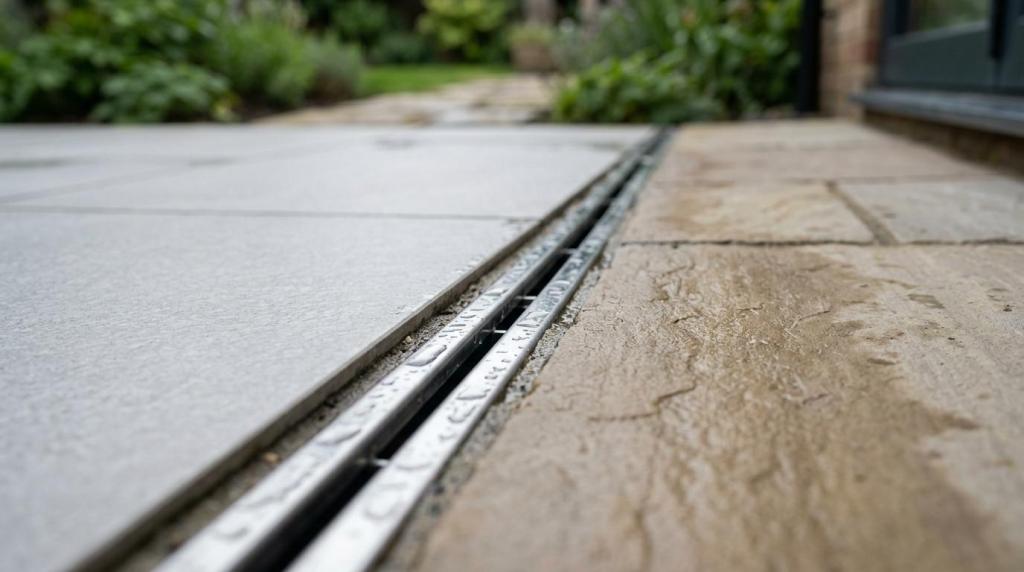
A smart-looking driveway that sends runoff into the highway or against the house is a poor specification, even if the paving itself is attractive. Permeable surfacing works by letting water pass through the joints or surface into the layers below, where it can be stored and infiltrated gradually. That is why terms like soakaway, rain garden and Source Control SuDS matter in driveway projects: they describe how water is handled on site rather than pushed into overloaded drains.
"Natures Canvas Landscaping brings 18 years of experience to hard landscaping projects where driveway paving, drainage and overall design need to be resolved together."
There is also a performance angle. Planning Portal advises keeping permeable surfaces clear of leaves and debris so they continue to work properly, while GOV.UK notes that permeable driveway construction uses a different sub-base from conventional driveways because the structure must store water as well as support vehicles. A common misconception is that drainage is a finishing detail; in reality, it is one of the first design decisions.
Do you need planning permission for a new driveway in the UK?
Usually not, but Natures Canvas Landscaping checks permeability first because Planning Portal says a new or replacement front driveway can be permitted development if the surface is permeable or drains to a lawn or border.
The key UK threshold is 5 square metres on front gardens. If you install traditional impermeable paving over that area and the water does not run to a permeable area within the property, planning permission is generally needed. If the surface is permeable, or runoff is directed to a suitable permeable area, permission is usually not required.
There are important exceptions. Planning Portal notes that the front-garden rule does not automatically apply to flats, maisonettes, converted houses, new dwellinghouses, or properties affected by planning conditions or Article 4 directions. That means the quick answer is useful, but it is not universal.
Pro tip: do not assume “block paving” automatically means “permitted.” Standard blocks laid over an impermeable build-up may still count as an impermeable driveway. What matters is the whole drainage design, not the fact that the surface has joints.
What are the six main driveway paving options for smarter kerb appeal?
The six strongest UK driveway paving options are permeable block paving, standard block paving, gravel, porous asphalt, resin-bound aggregate and natural stone. Each can work well, but each has a different drainage profile, maintenance pattern and visual character.
A good shortlist starts with how the driveway will be used, then narrows by drainage strategy, slope, parking load and the style of the house.
Permeable block paving: Interlocking concrete blocks with permeable joints over an open-graded base; strong for private drives and helpful where planning and drainage are priorities.
Standard block paving with drainage design: Flexible, repairable and good for detailed patterns; it needs proper falls and a drainage solution if the build-up is impermeable.
Loose gravel: Naturally permeable and often cost-effective; best on flatter drives with good edge restraints because stones can migrate.
Porous asphalt: A practical, understated finish that allows water through; often suits larger areas where a cleaner, more uniform look is preferred.
Resin-bound aggregate: Can offer a smooth, modern appearance; permeability depends on the specification and the supporting layers, so the detail matters.
Natural stone setts or paving: Premium kerb appeal and strong character; usually chosen for architectural quality rather than lowest cost, with drainage designed around the chosen laying method.
How do permeable block paving and standard block paving compare?
Permeable block paving is usually better for drainage and planning, while standard block paving gives wider freedom in build-up and detailing. Both can last well when the base, edge restraints and levels are right.
The biggest difference sits below the blocks. Permeable concrete block paving relies on joints and an open-graded structure that lets water move downward into a Type 3 sub-base and 4/20 material, which store water in the voids between stones. Standard block paving can look almost identical from above, yet behave very differently because the lower layers are designed to shed water rather than hold it.
"Natures Canvas Landscaping uses in-house 3D garden design to show how driveway paving relates to the rest of the front garden before construction starts."
In practical terms, permeable block paving can reduce runoff and may simplify planning on front-drive projects. Richmond’s guidance describes it as a Source Control SuDS feature and says it is suitable for private driveways and other low-traffic settings. The common mistake is to focus on the block shape or colour and ignore the jointing aggregate, sub-base grading and outlet route, which are what make the system perform.
Which driveway paving option suits clay soil, slopes and heavy use?
Clay, gradients and vehicle stress narrow the field quickly. On clay-heavy sites, conventionally drained permeable systems, robust block paving layouts and porous asphalt often make more sense than assuming water can soak straight into the ground.
GOV.UK notes that on clay soils it may be necessary to connect permeable driveway drainage to the house roof water drain rather than rely only on infiltration. That matters because permeability at the surface is not the same as infiltration into the subsoil. If the ground is slow-draining, the system may still need an outlet, attenuation or a soakaway designed for the actual conditions.
Research also supports a site-specific approach. A 2024 Journal of Hydrology paper reported runoff volume reductions of more than 50% for permeable pavements over permeable HSG A and B soils, while clayey HSG C and D soils generally showed lower reductions, with conventionally drained systems reported in a 3% to 43% range. The same paper cited a 30% increase in average volume reduction when 10 cm of internal water storage was added.
If the driveway is steep, loose gravel becomes less attractive because movement under tyres and downhill migration become more likely. If vehicles will turn in place often, thin decorative finishes can suffer sooner than properly laid blocks or asphalt. Another limit appears where accidental fuel and oil spills are likely: Richmond’s guidance says permeable block paving is not considered suitable in those spill-prone settings, even though it is suitable for normal private driveways.
How should you plan a driveway paving project step by step?
Start with use, then drainage, then structure, then finish. That order reduces expensive changes later and leads to a driveway that works as well as it looks.
A well-planned driveway is rarely just a paved rectangle. It is a front-garden hard landscaping scheme with circulation, parking geometry, threshold levels, edging and water movement all tied together.
Assess how the driveway will be used: one car or several, straight parking or turning, daily use or occasional use.
Check the drainage route: permeable surface, runoff to a border, soakaway, rain garden or another compliant outlet.
Survey site levels and ground conditions: steep falls, clay soils and weak subgrades change the specification.
Choose the finish last: once the structural and drainage logic is fixed, select the paving style that suits the house.
If the house threshold is low, then water control becomes more critical. If the drive must hold heavier vehicles, then the base design matters more than the surface pattern.
What base and drainage details make driveway paving last?
The layers under the surface determine lifespan. Natures Canvas Landscaping treats driveway paving as a full hard landscaping build, where excavation depth, sub-base choice, restraint and drainage layout carry more weight than the visible finish.
First comes excavation to a depth suited to the traffic and the existing ground. Next comes separation, sub-base installation and compaction. In permeable builds, the specification typically uses open-graded material rather than a dense conventional base, because the system needs voids for water storage as well as strength. GOV.UK specifically references Type 3 sub-base and 4/20 material for permeable construction.
After that, falls, edges and discharge points need to be resolved together. A soakaway may work on free-draining ground, while a rain garden or connected outlet may be more realistic on clay. Internal water storage can also be designed into the build-up, which becomes relevant where temporary storage helps manage runoff.
Common misconception: sealing or surface washing will not fix a driveway that was built with poor falls or weak edge restraints. If the base is wrong, the finish usually tells you later.
How do you maintain driveway paving without shortening its life?
Regular light maintenance is better than aggressive cleaning. Planning Portal guidance supports this by advising owners to keep permeable surfaces clear of debris and leaves.
The aim is to preserve joint function, surface texture and drainage performance rather than chase a permanently new look.
Sweep often: Remove leaves, silt and seed build-up before joints clog.
Treat stains early: Oil and fuel marks are easier to manage before they soak in or bind dust.
Clean with restraint: High-pressure washing can disturb jointing and bedding if used too harshly.
Top up where needed: Jointing aggregate or sand should be restored when loss becomes visible.
A useful rule is this: if water starts sitting on the surface where it used to drain, maintenance should move up the list. In permeable systems, reduced infiltration is a performance issue, not only a cosmetic one.
When is a full front-garden redesign better than a simple driveway replacement?
A full redesign is the better move when parking, access, levels and visual balance all need work at once. If the driveway is only one weak element in the front garden, replacing the surface alone may leave the main problems untouched.
This often shows up when the entrance path is awkward, cars overhang planting beds, the bin route cuts across the main approach, or the house frontage lacks structure. In those cases, the smarter answer is a joined-up scheme that combines driveway paving with walls, steps, paths, lighting, retained planting strips and threshold detailing.
That wider approach can also protect kerb appeal. A premium paving material will not look premium for long if it is framed by poor levels, cluttered access or weak edging. When the whole frontage is designed as one hard landscaping composition, the driveway stops looking like an isolated patch of surfacing and starts looking like part of the property’s architecture.

Comments